Development and optimization of tools for the study of human brain anatomical connectivity using high angular resolution diffusion MRI

Project Type: FONDECYT Initiation #11121644
Position: Principal Researcher
Award Year: 2012. Ending Year: 2015.

Descripción

This project sought to develop and optimize tools for the study and analysis of brain connectivity, using Difussion Magnetic Resonance Imaging (dMRI) data.

The studies are based on High Angular Resolution Difussion Imaging (HARDI) images.

These present very high quality, due to the advancement of acquisition technologies, as well as the acquisition itself (long duration, dedicated to research) and the performed post-processing, which seek to provide a solid base for the study of the healthy adult human brain.

The main results of this project contemplate:

  • The analysis of the reproducibility of short association fascicles of the brain, using data clustering tools and cortical parcellations.

  • The optimization of an algorithm for the segmentation of brain fibers, achieving times that allow an interactive segmentation (Principal Researcher: Professor Miguel Figueroa T.).

  • The development of a tool for the optimized visualization and manipulation of brain tracts.

Other interesting results are:

  • Development of a tool for the optimized visualization of tracts for Android devices (iFiber).

  • Creation of an atlas of short brain fascicles.

  • Development of algorithms for the comparison of brain tracts, between subjects and between hemispheres.

Undergraduate Theses related to the project

Student Thesis Defense Date
Ignacio Osorio W. Electronic Civil Engineering Thesis: “Software for the Interactive Visualization and Extraction of Brain Fibers” December 31st, 2015.
Danilo Bonometti B. Electronic Civil Engineering Thesis: “Visualization of Brain Fibers” April 1st, 2015.
Daniel Seguel B. Biomedical Civil Engineering Thesis: “Automatic Algorithm for the Segmentation of Short Association Fibers of the Human Brain” March 17th, 2015.
Claudio Román G. Biomedical Civil Engineering Thesis: “Short Brain Fibers Clustering Calculated from Difussion Magnetic Resonance Imaging Images” January 16th, 2015.
Miguel Guevara O. Biomedical Civil Engineering Thesis: “Algorithm for the Automatic Segmentation of Short Brain Fibers of the Fronto-Parietal Region and the Insular Cortex” January 16th, 2015.
Pablo L. Silva P. Biomedical Civil Engineering Thesis: “Parcellation of the Brain Cortex Based on the Anatomical Connectivity” May 29th, 2014.
Eduardo Venegas A. Electronic Civil Engineering Thesis: “Development of a software for the interactive manipulation of brain fibers” July 18th, 2014.
Nicole A. Labra A. Biomedical Civil Engineering Thesis: “Optimization of Algorithm for the Classification of White Matter Fibers based on the Brain Fascicles Atlas” April 30th, 2013.
Edison Pardo R. Electronic Civil Engineering Thesis: “Study of the Variability of the Connections of Short Association of the Human Brain” April 4th, 2013.
Gabriel E. Varela M. Biomedical Civil Engineering Thesis: “Calculation of Diffusion Tensor Indices from the Westin Algorithm” April 4th, 2013.

Postgraduate Theses related to the project

Student Thesis Defense Date
Claudio Román G. Master of Engineering Sciences w/m in Electrical Engineering.
“Segmentation of brain short brain fibers based on hierarchical Clustering from HARDI database”
November 30th, 2016.
Miguel Guevara O. Master of Engineering Sciences w/m in Electrical Engineering.
“Parcellation of the brain cortex based on fiber atlas calculated from tractography”
January 30th, 2016.
Nicole Labra A. Master of Engineering Sciences w/m in Electrical Engineering, (co-director)
“Quick segmentation of white substance brain fibers”
January 28th, 2015.

Publications

2811, 2018

FONDEQUIP for Education to analyse neurocognitive learning with engineers

Collaborating with relevant information in teacher training and motivating high level scientific production in real contexts with common social interactions, such as the classroom, are the objectives sought by the FONDEQUIP (CONICYT) project, adjudicated by Mabel Urrutia of the Faculty of Education, in collaboration with academics Pamela Guevara and Esteban Pino of the Faculty of Engineering, among others. The name of the project is "Acquisition of a portable electrophysiology device with wireless system for the study of innovative didactic methodologies, and its influence in learning at a neurocognitive level", an instrument that only existed in a university located in Santiago, that now will be in "Universidad de Concepción", and will be shared with "Universidad de O'Higgins" for a couple of months. The device, which allows for the acquisition of 4 simultaneous EEG, will allow the performing of various experiments, and the collaboration of researchers in the cognitive neuroscience area. This FONDEQUIP is associated to the "Proyecto Anillo ACT172121" project. More details at the full news.

2311, 2018

Mobile Application for Seniors in the Treatment of Arterial Hypertension

C. Vásquez, P. Guevara, R. Pinto, R. Iturra, C. Alvial, L. Sufán, A. Hernández, F. Venegas, R. Aguilera, M.P. Casanova, T. Moreno, M. Victoriano, I. Chamblás, P. Cid, H. Müller, M.J. Sepúlveda. Aplicación Móvil para Adultos Mayores en Tratamiento de la Hipertensión Arterial (Mobile Application for Seniors in the Treatment of Arterial Hypertension). I Seminar of Health Informatics, Valparaíso, Chile, 2017. First place, Paper contest.

1211, 2018

Brain State Dynamics Workshop in Valparaíso

On Monday, November 12th 2018, Brain Dynamics Lab organised the "Brain State Dynamics Workshop" at the Complex Systems Institute in Valparaíso.   At the Workshop, researcher Nelson Trujillo first presented the bases of the HsMM model, with his presentation titled "Dynamics state allocation using Hidden Semi Markov Models" .   Then, PhD student David Araya explained and taught a tutorial on the developed MatLab's "HsMM" toolbox. This work was carried out under the direction of El-Deredy. The PhD students and members of the Medical Images Analysis Group, Liset González and Hernán Hernández, assisted the event, as well as professor Pamela Guevara.   On November 19th, researcher Nelson Trujillo also presented "A probabilistic approximation to the modelling and analysis of functional Neuroimages", at Universidad de Concepción, in Concepción.

1209, 2018

Students from the Concepción Industrial Lyceum learn about study of the brain and VR

Wednesday, September 12th, students from Freshmen to Seniors of the Concepción Industrial Lyceum learnt about the study of the brain via brain Magnetic Resonance images, and the exploration of the brain via Virtual Reality. The activity was organized by the biology teacher, Valerey Muñoz, and the chemistry teacher, Víctor Hernández, thanks to the CONICYT Explore Program and its initiative "1000 Scientists, 1000 Classrooms", that seeks to bring scientists to schools and lyceums, to share their knowledge and experiences. In this activity, professor Pamela Guevara presented basic concepts about the acquisition and analysis of Magnetic Resonance images for the study of the brain, and projects made in the context of Projects FONDECYT 1161427 and CONICYT PIA/"Anillo de Investigación en Ciencia y Tecnología ACT172121". Afterwards, the alumnus of Biomedical Civil Engineering, Ignacio Espinoza, exhibited his Thesis, which consisted of the development of a Virtual Reality application for the 3D exploration of the brain, financed by the same project. The application allows to know the lobes, convolutions, subcortical structures and main fascicles of the brain fibers. It was made using Unity and Blender software, and allows for the interaction between the Oculus Rift virtual reality lens and the Leap Motion device. Exposition Title: "Study of the brain via Brain Magnetic Resonance and Virtual Reality" Description: "The brain is one of the most studied organs of the human body. It's special due to its complexity and the great amount of functions that performs and controls. Magnetic Resonance (MR) images are increasingly used for the study of the brain, as well as for the diagnostic of various diseases. The most utilized ones are anatomical images, through which the volume, form, and appearance of different structures can be studied. There's also MR images weighted by diffusion, which allow to reconstruct the main brain fibers. In this exposition it is roughly explained the content and utilization of these images. A Virtual Reality demo is included, for the exploration of different brain structures, developed at Universidad de Concepción."  

1109, 2018

Students from Mozart School learn about the study of the brain

Friday, September 7th, seven Juniors and Seniors from Mozart School, along with their Physics teacher, Pablo Beltrán, attended to talks organized by the Department of Informatics Engineering and Computer Sciences. First, professor Javier Vidal showed projects made in a practical subject, by freshmen of Informatics Civil Engineering, where they use the Arduino platform. Then, the master's student, Andrea Vásquez, and the Biomedical Civil Engineering student, Felipe Silva, presented the study of the brain made by the Medical Image Analysis Group, led by professor Pamela Guevara, in collaboration with professor Cecilia Hernández. After the description of neurons, brain fibers, and the brain in general, they showed results of the FONDECYT 1161427 and CONICYT PIA/"Anillo de Investigación en Ciencia y Tecnología ACT172121" Projects. In particular, a method for the fast clustering of brain fibers obtained with Difussion Magnetic Resonance Imaging was presented, as well as the study of their connectivity and visualization. This extension activity had the goal of motivating the students towards Computing and its relation with other areas.

509, 2018

Students of the Medical Images Analysis Group defend their works

In the last months, various students from the Medical Images Analysis Group have defended their works, which have been developed in the context of the FONDECYT 1161427 Project. In the month of July, Andrea Vásquez, presented her Masters in Computer Science Thesis proposal, titled: "Efficient method for the clustering of brain fibers based on parallel algorithm on GPU", codirected by professor Cecilia Hernández. In the month of August, Narciso López defended his PhD in Computer Science Thesis proposal, titled: "Parcellation of the brain cortex from the segmentation of short fiber fascicles". Two students also defended their Biomedical Civil Engineering Thesis: Ignacio Espinoza, with his work "Virtual Reality Software for the 3D Exploration of the Brain", and Daniela Pinto, with the topic "Segmentation of short Brain Fibers based on its form starting from Difussion Magnetic Resonance Imaging images". All of these works contribute with the objective of developing tools that allow for a more detailed study of the brain connectivity, both in healthy subjects, as in patients.

Load More Posts

News

1106, 2019

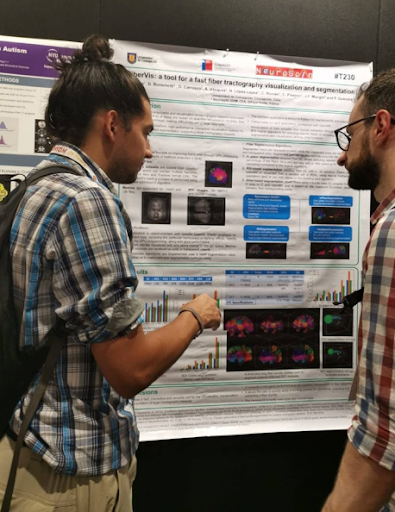
Ignacio Osorio Wallace presented at OHBM 2019 (the Organization for Human Brain Mapping annual meeting)

On June 11th 2019, Electronic Engineer Ignacio Osorio Wallace participated in OHBM (Organization for Human Brain Mapping) 2019, where he presented a paper entitled "FiberVis: [...]

Load More Posts
2018-11-10T18:32:47-03:00