Development and optimization of tools for the study of human brain anatomical connectivity using high angular resolution diffusion MRI

Project Type: FONDECYT Initiation #11121644
Position: Principal Researcher
Award Year: 2012. Ending Year: 2015.

Descripción

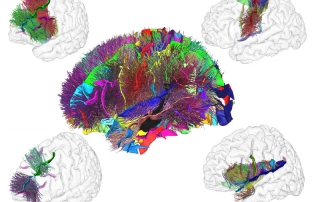
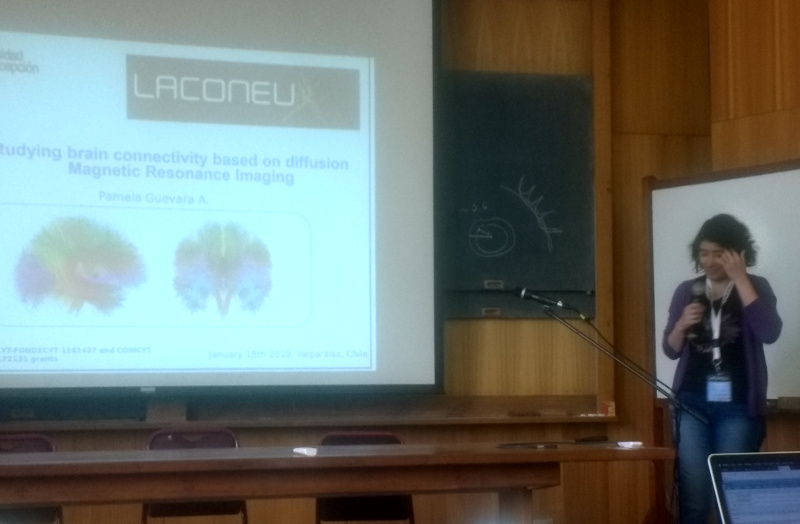
This project sought to develop and optimize tools for the study and analysis of brain connectivity, using Difussion Magnetic Resonance Imaging (dMRI) data.

The studies are based on High Angular Resolution Difussion Imaging (HARDI) images.

These present very high quality, due to the advancement of acquisition technologies, as well as the acquisition itself (long duration, dedicated to research) and the performed post-processing, which seek to provide a solid base for the study of the healthy adult human brain.

The main results of this project contemplate:

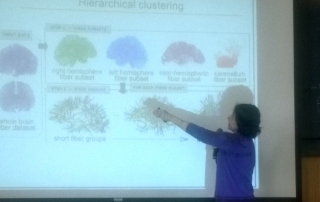
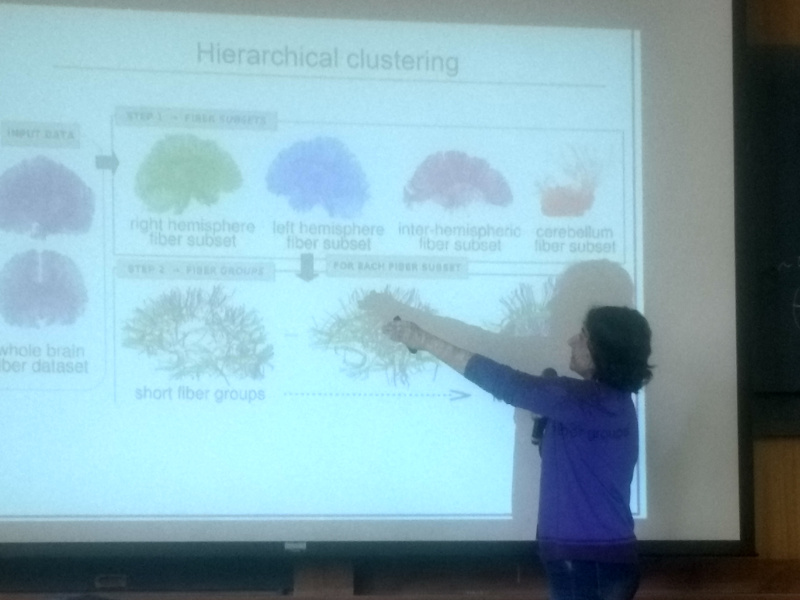
  • The analysis of the reproducibility of short association fascicles of the brain, using data clustering tools and cortical parcellations.

  • The optimization of an algorithm for the segmentation of brain fibers, achieving times that allow an interactive segmentation (Principal Researcher: Professor Miguel Figueroa T.).

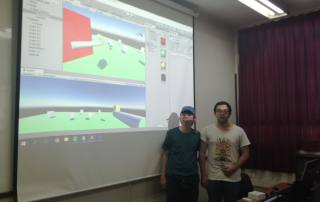
  • The development of a tool for the optimized visualization and manipulation of brain tracts.

Other interesting results are:

  • Development of a tool for the optimized visualization of tracts for Android devices (iFiber).

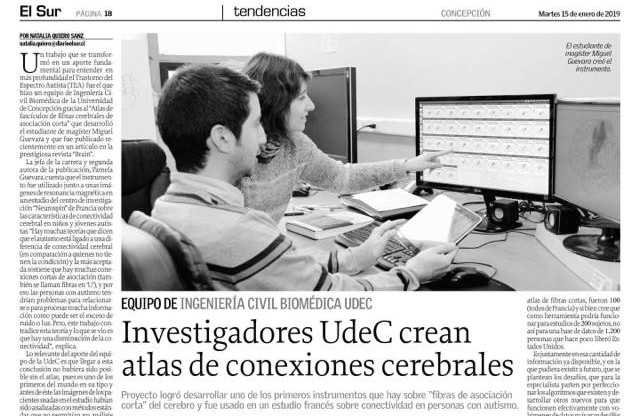
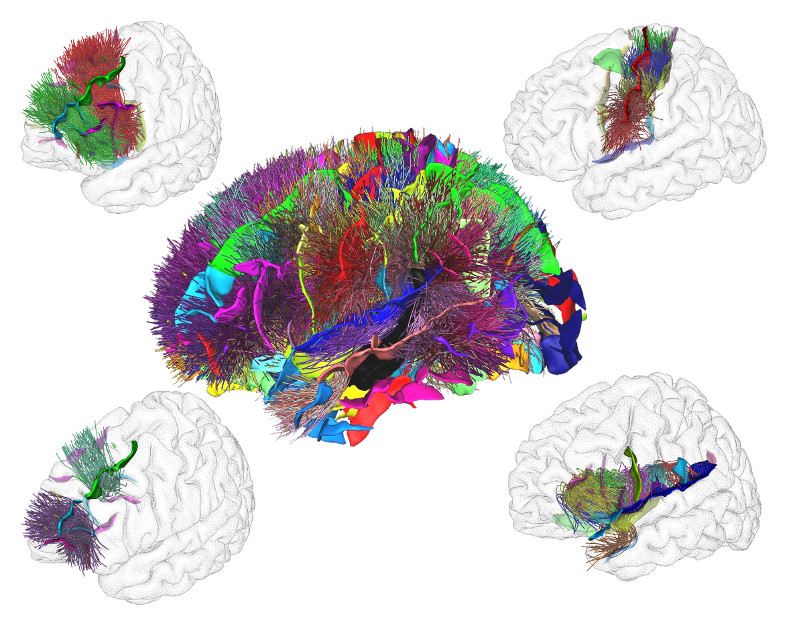
  • Creation of an atlas of short brain fascicles.

  • Development of algorithms for the comparison of brain tracts, between subjects and between hemispheres.

Undergraduate Theses related to the project

Student Thesis Defense Date
Ignacio Osorio W. Electronic Civil Engineering Thesis: “Software for the Interactive Visualization and Extraction of Brain Fibers” December 31st, 2015.
Danilo Bonometti B. Electronic Civil Engineering Thesis: “Visualization of Brain Fibers” April 1st, 2015.
Daniel Seguel B. Biomedical Civil Engineering Thesis: “Automatic Algorithm for the Segmentation of Short Association Fibers of the Human Brain” March 17th, 2015.
Claudio Román G. Biomedical Civil Engineering Thesis: “Short Brain Fibers Clustering Calculated from Difussion Magnetic Resonance Imaging Images” January 16th, 2015.
Miguel Guevara O. Biomedical Civil Engineering Thesis: “Algorithm for the Automatic Segmentation of Short Brain Fibers of the Fronto-Parietal Region and the Insular Cortex” January 16th, 2015.
Pablo L. Silva P. Biomedical Civil Engineering Thesis: “Parcellation of the Brain Cortex Based on the Anatomical Connectivity” May 29th, 2014.
Eduardo Venegas A. Electronic Civil Engineering Thesis: “Development of a software for the interactive manipulation of brain fibers” July 18th, 2014.
Nicole A. Labra A. Biomedical Civil Engineering Thesis: “Optimization of Algorithm for the Classification of White Matter Fibers based on the Brain Fascicles Atlas” April 30th, 2013.
Edison Pardo R. Electronic Civil Engineering Thesis: “Study of the Variability of the Connections of Short Association of the Human Brain” April 4th, 2013.
Gabriel E. Varela M. Biomedical Civil Engineering Thesis: “Calculation of Diffusion Tensor Indices from the Westin Algorithm” April 4th, 2013.

Postgraduate Theses related to the project

Student Thesis Defense Date
Claudio Román G. Master of Engineering Sciences w/m in Electrical Engineering.
“Segmentation of brain short brain fibers based on hierarchical Clustering from HARDI database”
November 30th, 2016.
Miguel Guevara O. Master of Engineering Sciences w/m in Electrical Engineering.
“Parcellation of the brain cortex based on fiber atlas calculated from tractography”
January 30th, 2016.
Nicole Labra A. Master of Engineering Sciences w/m in Electrical Engineering, (co-director)
“Quick segmentation of white substance brain fibers”
January 28th, 2015.

Publications

1505, 2018

Professor Pamela Guevara in “Women in Science and Technology” report

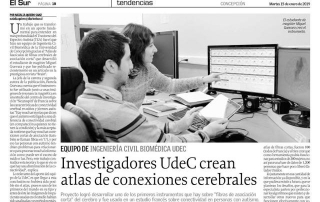
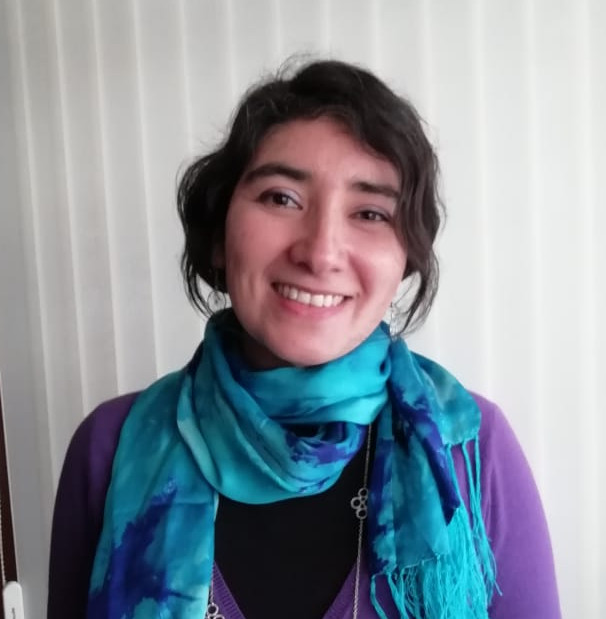
Professor Pamela Guevara appeared in a reportage from El Sur newspaper titled "Women in Science: family determines the freedom to dare", along with two other young professionals of the area. In this, the academic and current Biomedical Civil Engineering Director talks about her time as a student at Universidad de Concepción, the gender gap in her major, and the importance of her parents' support and motivation for her to study whatever she wanted, no matter the prejudice associated to a woman in science. When I was a kid my interest was always towards science. And my parents always encouraged me to study whatever I wanted, and they really liked that I choose engineering, not only because my dad was one, but also because they know I liked everything about engineering. The article aims to highlight the importance of family support in women and young female students that wish to develop in science and technology, with the goal of overcoming the prejudices associated to them in STEM (Sciente, Technology, Engineering, Mathematics) vocations. Regarding that, professor Pamela says: Since very little, girls are encouraged and congratulated by looking pretty, smile or having a nice gesture; and the boys when they achieve concrete objective, like solving a puzzle... ...I believe that the fear to participate or encourage STEM vocations in girls and young females is because there is ignorance that, in fact, there are no difference between the development of boys and girls, as people usually think. Source: Diario El Sur. Complete reportage in http://www.elsur.cl/impresa/2018/04/24/full/cuerpo-principal/16/.  

1405, 2018

Professor Pamela Guevara distinguished in 100 Female UdeC Engineers Campaign

Professor Pamela Guevara, Biomedical Civil Engineering Director, Electronic Civil Engineer from UdeC, PhD in Physics of Paris-Sud University (France) is one of the few people that work on difussion Magnetic Resonance in Latin America. It counts with international level researchs and publications in the most prestigious journals of the area. She was highlighted in the "100 Female UdeC Engineers", Faculty of Engineering, University of Concepción. Full interview at: http://www.ing.udec.cl/…/nosotras-creemos-en-la-igualdad-o…/.

1603, 2018

A novel method to detect fractional anisotropy differences in short association fibers discriminated by their functional connectivity between Multiple Sclerosis patients and healthy subjects.

C. Montalba, M. Zurita, T. Labbé, P. Guevara , C. Carcamo , J. P. Cruz , C. Sing-Long, M. Andia, S. Uribe. A novel method to detect fractional anisotropy differences in short association fibers discriminated by their functional connectivity between Multiple Sclerosis patients and healthy subjects. In International Society of Magnetic Resonance in Medicine conference, ISMRM 2018, Paris, France, 2018.

1603, 2018

Clustering of tractography datasets based on streamline point distribution.

A. Sánchez, C. Hernández, C. Poupon, J.-F. Mangin, P. Guevara. Clustering of tractography datasets based on streamline point distribution. In International Society of Magnetic Resonance in Medicine conference, ISMRM 2018, Paris, France, 2018. http://cds.ismrm.org/protected/18MPresentations/abstracts/1567.html

103, 2018

Development of new tools for the study of human brain connectomics

Project Type: Regular FONDECYT #1161427 Position: Head Researcher Award Year: 2016. Ending Year: 2019. This project aims to continue with the development and optimization of tools for the study and analysis of the brain connectomics, using data mainly from Diffusion Magnetic Resonance Imaging (dMRI), focused on the study of the Human Connectome. The study of the Human Connectome has awakened a great interested in the scientific community for some years, and has promoted large initiatives like the Human Connectome Project (http://www.humanconnectomeproject.org/) or the Human Brain Project (https://www.humanbrainproject.eu/). Its main objective is to know in more detail the structure and operation of the brain and be able to construct a diagram of the brain regions and their connections. In this analysis a large quantity of modalities, and they involve the study of anatomical, functional, and clinical data, among others. In the case of this project, the studies are based in the study of the connectivity, based mainly on High Angular Resolution Diffusion Imaging (HARDI) images. The main objective is to provide the community with new tools that allow the construction of connectomes, more representative of the underlying anatomical connectivity. The developments aim to: Improve the analysis of the reproducibility of short association fascicles of the brain. Continue the development of the optimized brain tracts visualization and manipulation tool. Develop a new fiber clustering algorithm based on the form. Evaluate the feasibility of creating a cortical parcellation starting from brain fibers fascicles. Undergraduate Theses related to the project Student Thesis Defense Date Felipe Silva V. Biomedical Engineering Thesis: "Cortical parcellation method based on a graph representation of brain connections" April 1st, 2019. Daniela Pinto D. Biomedical Engineering Thesis: “Segmentation of short brain fibers based on their form starting from difussion magnetic resonance imaging.” August 30th, 2018. Ignacio Espinoza C. Biomedical Engineering Thesis: “Virtual reality software for the exploration of the brain in 3D.” August 29th, 2018. Claudio Huaiqueo T. Biomedical Engineering Thesis: “Parcellation of the brain cortex starting from fiber fascicles.” April 5th, 2018. Diego Carrasco V. Electronic Engineering Thesis: “Brain fibers visualization and manipulation software” December 30th, 2016. Edgardo Cabrera F. Electronic Engineering Thesis: “Brain fibers clustering using distance measure based on the form” August 22nd, 2016. Postgraduate Theses related to the project Student Thesis Defense Date Claudio Román G. Master in Engineering Sciences w/m in Electrical Engineering. “Segmentation of short brain fibers based on hierarchical Clustering based on HARDI database” January 26th, 2017. Miguel Guevara O. Master in Engineering Sciences w/m in Electrical Engineering. “Parcellation of the brain cortex based on fiber atlas calculated from tractography” January 30th, 2016. Publications News

Load More Posts

News

501, 2019

Prof. Pamela Guevara joins important international IEEE technical committee

Professor Pamela Guevara was accepted as an associate member of the "Bio Imaging and Signal Processing" (BISP) Technical Committee, of the IEEE's Signal Processing Society (SPS), [...]
Load More Posts
2018-11-10T18:32:47-03:00